In this article
Christmas crochet can be a single ornament, a useful gift or a small textile that returns to the room each winter. Choosing one role first makes the project easier to plan. A branch decoration, a stocking and a table runner need different dimensions, finishing and ways to be stored after the season.
This guide helps you compare those directions before choosing complete instructions. The pictures are design inspiration, so they do not supply stitch counts or prove how a material behaves. Use a pattern for the actual construction and choose the project around the home, recipient and time available. A limited palette can make several small items feel coordinated, but there is no need to produce a whole collection to make something worth keeping.
Choose where the finished item will live
Start with the actual location: a shelf, tree branch, mantel, table or wrapped gift. Measure the available space and consider how the piece will be supported. A hanging ornament needs a secure appropriate loop and a suitable branch; a standing figure needs its intended base; a table textile needs enough room without crowding place settings. Keep the scale tied to that location.
Treat seasonal decor as decor. Keep yarn and hanging cords away from flames, heat sources and places where they could create a hazard. Do not add lights, wire or unplanned weighting materials simply to copy an image. If a design includes extra components, choose suitable complete instructions and consider the actual household, including children and pets.
Ornaments: compare flat motifs and stuffed shapes
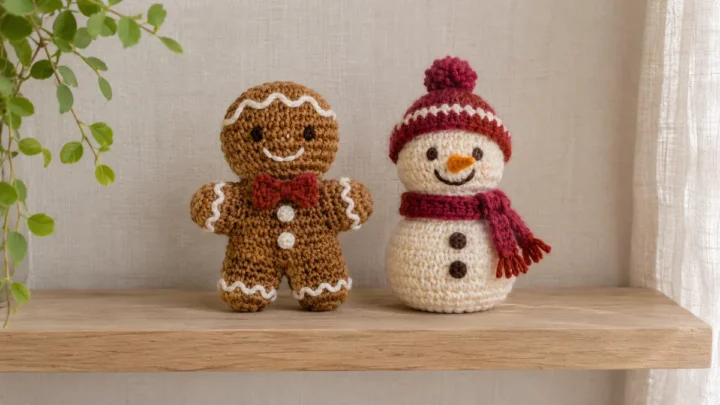
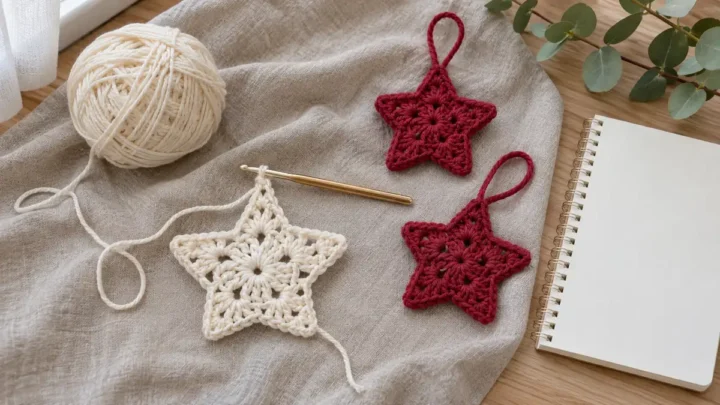
Flat stars, snowflakes and small geometric motifs keep the profile shallow and can be stored without much depth. Their edge treatment and finished flatness matter. A small stuffed ornament adds volume and introduces filling and closure tasks. Neither category has a fixed difficulty: a fine thread snowflake can be more demanding than a plain larger shape.
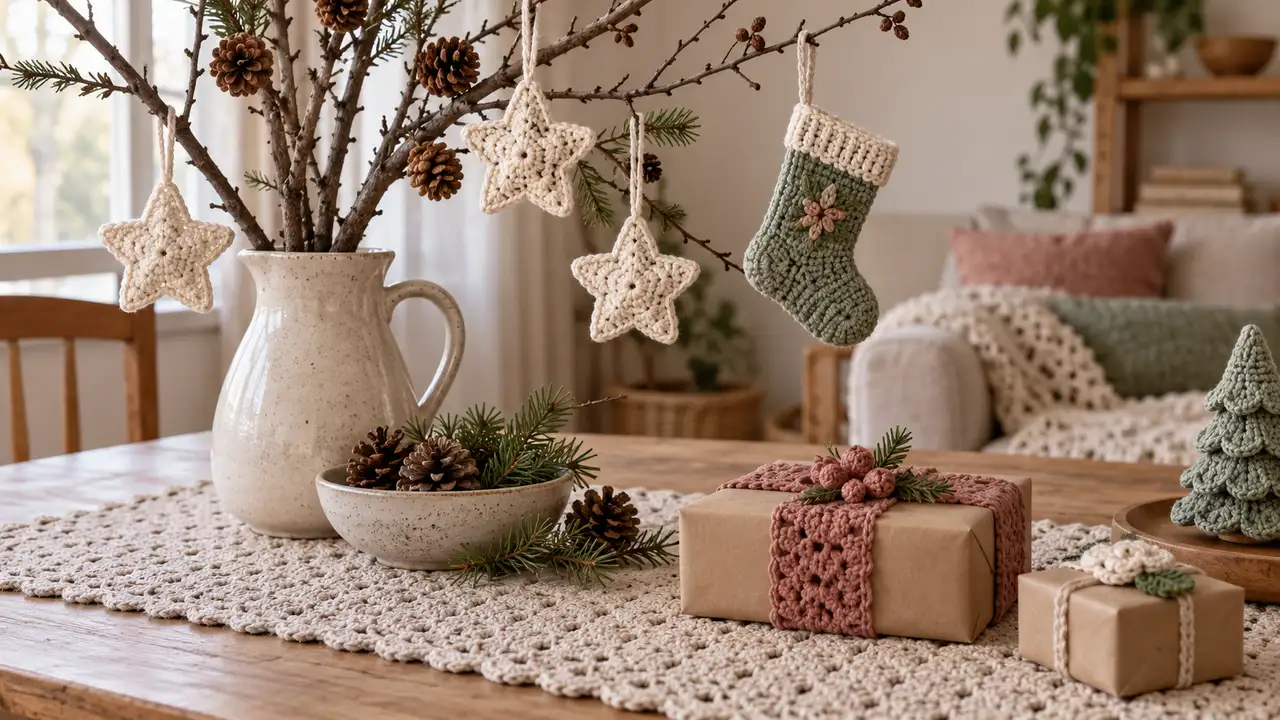
Check the pattern’s finished dimensions, yarn and any recommended blocking before choosing the material. Keep a decorative loop securely attached as directed and choose its length for the actual display. If matching several ornaments, finish one first and compare its size and weight with the branch or hook before repeating the design.
Stockings: plan size, opening and hanging method
A decorative stocking brings together a shaped foot, leg, cuff and hanging loop. Read all four sections before starting. A miniature version is not necessarily a simple scaled-down large stocking; the heel and opening may need different instructions. Decide whether the stocking is a display piece or will hold a few modest gifts, and follow a pattern intended for that use.
Do not infer carrying capacity from a thick-looking fabric. The loop and its attachment are part of the complete construction, and an overloaded stocking can distort or fail. Check the finished opening against anything you plan to place inside. Keep the display away from fireplaces or other heat even if the seasonal photograph that inspired it uses a mantel.
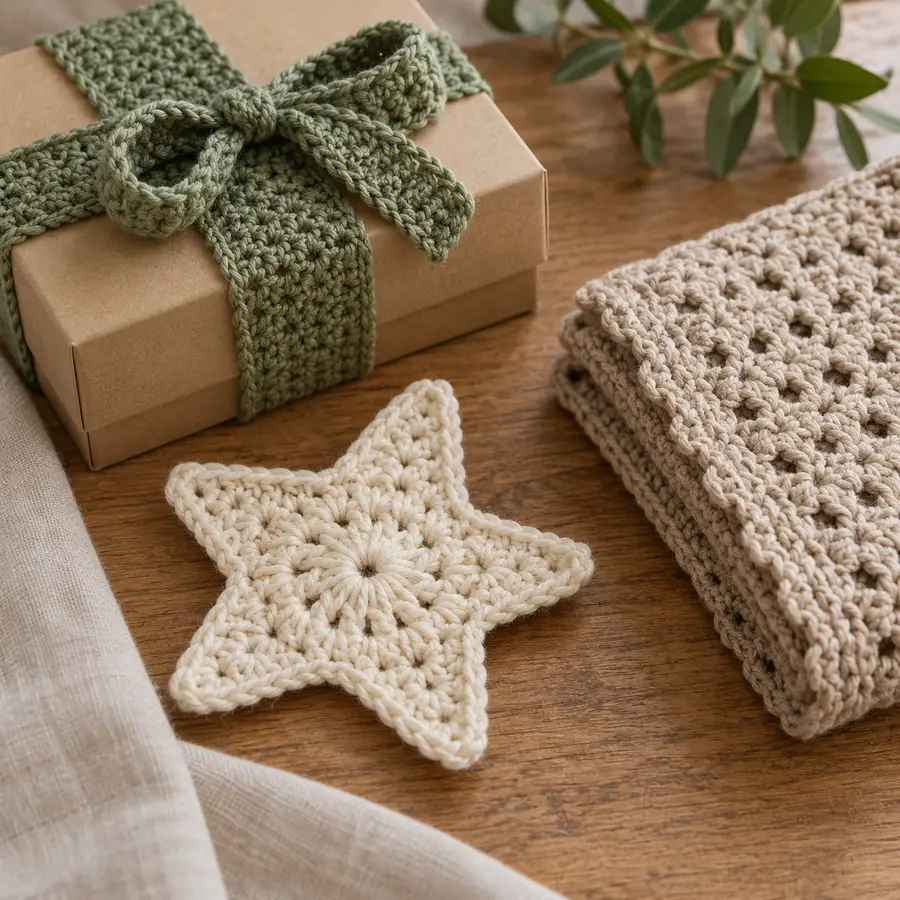
Winter home textiles: choose a manageable surface
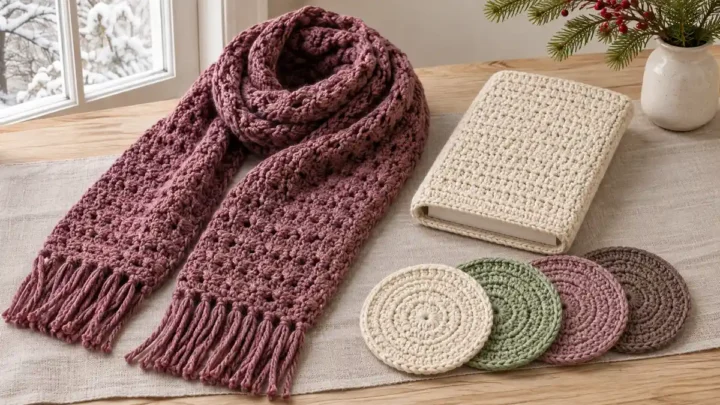
A small runner, cushion cover or coaster set can bring seasonal color into an existing room without replacing larger furnishings. Measure the table, insert or usable cup area and choose a pattern that fits. A restrained texture may work beyond December, making the item easier to use for a longer season.
Keep function distinct from appearance. Ordinary crochet coasters and runners are decorative surfaces; their fibers and thickness do not establish protection from hot cookware or flame. Use appropriate protective products where heat is involved. Check that cups and other objects sit steadily on a flat finished fabric before making the textile part of an everyday setup.
Reusable wrapping: fit the package and closure
A flat crochet band, small envelope or reusable tie can make the wrapping part of the present. Measure the actual box or card and choose a closure that can be opened without cutting the fabric. Keep the construction simple enough that the recipient can use it again. Avoid covering product or care information that needs to remain available.
If you are making several bands, use consistent package dimensions and finish one before repeating it. Count ties, ends and seams in the time plan. A single clear color detail can coordinate the wrapping with an ornament without requiring a separate elaborate motif for every box.
Select yarn for the actual pattern and care
Choose the yarn from the written design rather than substituting because two balls look similarly festive. Fine thread, ordinary plied yarn and bulky yarn behave differently in small edges and shaped pieces. Smooth visible yarn may make tiny repeats easier to count; highly textured or fuzzy materials can obscure the stitches. Check whether the intended result depends on finishing or blocking.
The Craft Yarn Council yarn categories help identify the thickness category in a materials list. They do not replace the pattern’s sample, dimensions or care requirements. Use the actual labels and check a finished sample before making many matching pieces.
Plan the quantity before the season gets busy
Make one complete sample early enough to change direction. Record how long the crochet and finishing take, plus the materials used. Add drying time if you wash or block it, and leave room for packaging. A small ornament repeated twenty times is still a substantial project, particularly when each one has several ends or a separate loop.
Choose a useful stopping point. One ornament per household, a modest coaster pair or a single stocking can be a complete gift. Reducing quantity is preferable to rushing joins or care. For presents unrelated to Christmas motifs, use the recipient and budget gift planner to choose something the person will use throughout the year.
Store the finished work for another season
Follow the actual materials’ care instructions, let the pieces dry fully and store them without crushing shaped details. A shallow box can keep flat motifs together, while stuffed shapes need room for their volume. Keep a note of the yarn and pattern with the set so a replacement or repair does not depend on memory next year.
Inspect hanging loops and joins when bringing the decorations out again. A tidy appearance in storage does not show every weakened attachment. Repair or retire damaged pieces before displaying them, and reconsider the location if the household’s needs have changed.
A seasonal checklist from sample to storage
- Before making multiples: finish one sample and check it in the actual display space.
- Before giving or displaying: inspect loops, joins, care information and the intended location.
- Before packing away: let every piece dry fully and give shaped details enough room.
- Before next season: inspect attachments again and keep the materials and pattern notes with the set.
Choose one seasonal project with a clear purpose
Decide where it will live, measure the space and make one complete sample. For small presents, compare the weekend gift ideas or modest thank-you gifts. Keep the design, making schedule and storage simple enough that the finished piece remains useful after the wrapping is opened.
- 13 Crochet Gingerbread and Snowman Decoration Ideas
Browse 13 crochet gingerbread and snowman decoration ideas, comparing flat motifs, padded figures, panels and simple seasonal pairings.
- How to Plan Handmade Christmas Projects Before the Holidays
Plan handmade Christmas projects from actual handover dates, recipient needs, complete samples, realistic sessions and a manageable display list.
- 23 Crochet Christmas Gift Ideas for Family
Find 23 crochet Christmas gift ideas for family, with notes on recipient use, measured fit, complete assembly and a clear care handover.
- 15 Crochet Christmas Tree Skirt Styles
Explore 15 crochet Christmas tree skirt styles by footprint, center opening, access split, border and closure before choosing a complete pattern.
- 17 Crochet Christmas Garland Inspirations
Compare 17 crochet Christmas garland inspirations by motif, spacing and display span, with notes on connections, background and storage.
- How to Choose Yarn for Durable Crochet Ornaments
Choose yarn for crochet ornaments by construction, visible detail, care and display. Build one sample before planning a matching seasonal set.
- 21 Crochet Christmas Stocking Design Ideas
Compare 21 crochet Christmas stocking designs by shape, cuff, texture and construction, with practical guidance on lining, joins and hanging details.
- 19 Crochet Snowflake Ideas for Winter Decorations
Browse 19 crochet snowflake ideas with different centers, arms and openwork, plus practical ways to compare flatness, display and seasonal storage.
- 25 Crochet Christmas Ornament Ideas for Handmade Trees
Explore 25 crochet Christmas ornament ideas, from flat stars to small padded shapes, with useful notes on loops, reverse sides, display and finishing.