In this article
Choose blanket yarn by the fabric you want to live with: its weight, drape, care and feel. Then use the hook that produces the pattern’s required gauge with that yarn. Estimate the quantity from the complete pattern first; when you are planning your own plain blanket, a representative finished swatch gives you a more useful starting point than a blanket-size chart alone.
This guide walks through those decisions in order. You will need a pattern or a clear plan for a simple flat blanket, the intended yarn, a suitable hook, a ruler, a scale that can measure the sample reliably and the yarn label. The arithmetic example uses invented measurements to demonstrate the method, not a tested blanket recipe.
Start with the blanket’s job
A reading throw, a bed-end accent and a full bed covering ask for different dimensions and amounts of fabric. Measure the place it will be used and decide how far it should drape. Write the intended finished width and length in one unit. Changing a small lap throw into a bed blanket affects more than the starting chain: the border, joins and total weight change too.
Think about care before choosing a fiber or texture. Read the actual yarn label and consider whether the finished blanket can be washed and dried in a way that fits its owner’s routine. Two yarns with the same weight-category number can still behave differently, so compare a real sample rather than treating the category as a complete specification.
1. Check the pattern, yarn label and units
Record the yarn’s fiber content, category, ball weight, length per ball, care instructions and dye lot when provided. Record the pattern’s finished dimensions, stitch pattern, gauge, yarn quantity and whether that quantity includes a border. Keep metres with metres or yards with yards throughout a calculation; do not mix them silently.
The Craft Yarn Council yarn-weight system groups yarns by thickness. Its hook ranges are starting guidance; the selected pattern and your fabric determine the working combination.
Checkpoint: you can explain which measurements refer to the blanket, which describe the swatch and which describe the yarn package. A 100 g ball is a mass, not a fixed length of yarn. Different yarns can have very different lengths in the same package weight.
2. Make a representative swatch
Use the actual yarn, hook and stitch pattern. Make the sample large enough to measure an interior area without relying on the edge stitches. Follow the pattern’s instructions for whether gauge is measured before or after finishing, and follow the yarn’s care limits. Let a washed sample dry fully before weighing or measuring it.
For a visual explanation of measuring away from the edges, see WeCrochet’s gauge lesson. Count stitches and rows over the span specified by your pattern and record the result with the hook size.
Checkpoint: the sample matches the required gauge and feels suitable for the intended blanket. If it does not, make one controlled adjustment and swatch again. A larger hook often gives fewer stitches in the same width, while a smaller one often gives more, but confirm the result in the actual stitch rather than relying on the direction of the change alone.
3. Estimate a plain blanket body from the sample
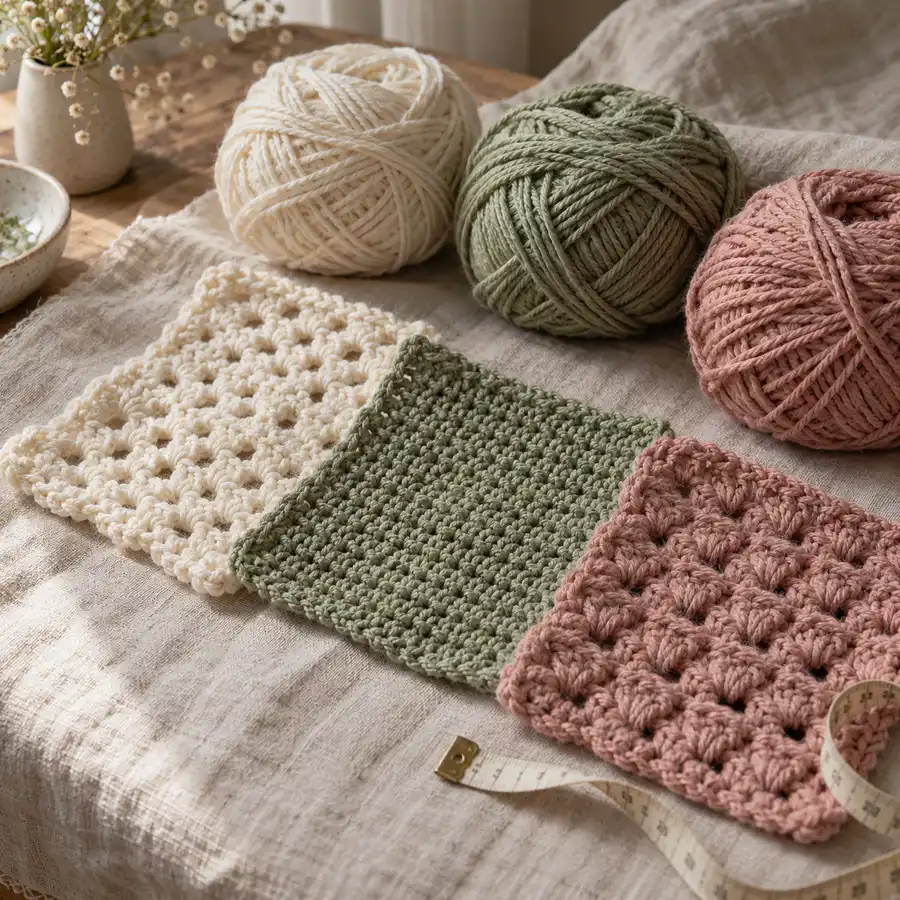
For a simple blanket made from the same repeated fabric, compare the intended body area with the area of the finished sample. Use the full sample’s finished area and the yarn mass actually used for it, accounting for any long tails or other yarn you have included. A very small sample or a scale that cannot distinguish its weight will give a poor estimate.
- Body area ÷ sample area = the number of sample-sized areas in the blanket body.
- That ratio × yarn mass in the sample = estimated body yarn mass.
- Label length ÷ label mass = approximate yarn length per gram.
- Estimated body mass × length per gram = estimated body length of yarn.
Here is an illustrative example. A finished 20 × 20 cm sample uses 20 g of yarn. A planned 100 × 140 cm body has 14,000 cm² of area, compared with the sample’s 400 cm². The ratio is 35, so the body estimate is 35 × 20 g = 700 g. If the label gives 200 m per 100 g, that is 2 m per gram, or about 1,400 m for the body.
Checkpoint: all of the dimensions describe the same stitch, yarn, hook and finishing process. This area method is an approximation for repeated flat fabric. It is not a reliable shortcut for changing textures, openwork proportions, mixed-size motifs or an elaborate border; those parts need their own samples or pattern quantities.
4. Add the border, joins and finishing separately
Use the border pattern’s stated requirement or measure a representative section. Account for joins, seams, tassels if used, secured ends and any extra sample yarn that will not be reused. There is no single percentage that fits every blanket. A deep textured border can have a very different requirement from a narrow plain edge.
Continuing the hypothetical example, suppose your separate border estimate is 100 m and your measured joining and finishing plan adds 50 m. The total becomes 1,550 m. At 200 m per ball, 1,550 ÷ 200 = 7.75, so you would round up to 8 full balls. This demonstrates rounding only; use your own measured allowances and decide on any additional reserve before ordering.
Lion Brand’s explanation of yardage per skein is useful when comparing package sizes. Compare the total length required, rather than replacing one brand’s number of balls with another brand’s same number of balls.
5. Check the first full-width section
After the first section, compare its width and fabric with your plan before continuing for many rows. Recheck your stitch count and note the yarn used. A change in tension or a misunderstood repeat is easier to resolve here than after the whole blanket is made. If the actual use differs strongly from the estimate, pause and revise the plan rather than hoping the remaining balls will stretch further.
Common planning problems
- The fabric is too stiff: reconsider the yarn, stitch and hook together, then make a fresh sample rather than changing the hook halfway through.
- The sample matches width but not row gauge: check the pattern’s height instructions; do not assume the correct width guarantees the correct length.
- You changed yarn category: recheck gauge, drape, dimensions and quantity. The same starting chain may no longer make the same blanket.
- Several strands are held together: account for every strand’s yarn consumption and keep the combination consistent.
Frequently asked questions
Is thicker yarn always quicker for a blanket?
It can build fabric in larger stitches, but the size, texture, handling and finishing still determine the work. A thick blanket can also become heavy. Choose the fabric you want to use rather than a finishing-time promise.
Can I use leftover yarn for the estimate?
Only if the sample represents the yarn and construction of the actual blanket. Mixed fibers, thicknesses and care requirements make a single sample less useful. A leftover-yarn design needs a plan for those differences.
Do I need a scale if I already have a complete pattern?
Start with the pattern’s stated yarn quantity and match its requirements. A scale-based estimate is an additional planning tool, especially for your own simple repeated fabric; it does not replace the pattern’s gauge and sizing instructions.
Choose a blanket direction
Use the crochet blanket planning guide to compare construction, or browse 17 chunky bedroom throw ideas for a visual starting point. If you are still building confidence with supplies, return to the beginner crochet starter kit. Choose one fabric, one use and one measured plan before buying a large quantity.